

Course Material Reflections
Brief and Strategy | Interviews
How do you develop a strategy and project plan for a client/ audience in a continually evolving global market.
Torsten Posselt FELD, Studio for Digital Crafts, Berlin
- Although Torsten highlighted structural and technical considerations of project strategy, he expressed a human approach, emphasising the importance of effective communication within client based work. There are an infinite variety of ways to approach projects, however due to the uniqueness and nuances in every collaboration, strategic approach should be defined in accordance with the nature of the individual client and product, established ideally through face to face interaction (although in a global market place this is not always possible).
- Torsten also emphasised the importance of creating ‘“an environment where you can be very free and very flexible” which resonates with the experience of the self initiated brief which enabled and somewhat required constant reflection and reinvention.
Matthew Jones and Michelle Dona: Accept & Proceed, London
“Our process at Accept & Proceed, it’s really to do deep-dive audience insight research and have conversations. We get out on the streets. We reach out to the people that we know, the consumer for that client, or potentially not the consumer for that client, but who will have an opinion on it and can give us insight, but we’re necessarily not seeing it as an agency. We start every process with the client in a very deep-dive workshop setting, where we take our experience and our insights as a design agency and a strategy agency. The audience insights that we’ve captured around that market and their opinion–then we take that in and we have a very kind of intimate setting with our clients, where we talk through this and we work through really the foundation so for any project, right at the upfront start. It’s a very important process for us and really allows us to have those open discussions about where the market’s at, at the moment. How the clients sees their product, how they see their brief.”
Wouter Dirks Studio Dumbar, Rotterdam
- Wouter Dirks discussed formal research tactics including brand workshops and desk based research on client, product and brief, however he also had a multidisciplinary research approach, encouraging an awareness of the client’s experience of global evolution in order to anticipate their needs. This idea expanded into the benefits of cultural diversity within teams as in a global market place, insight from a range of cultural perspective’s is increasingly important.
Glug, (2018) Katee Hui. Available at: https://glugevents.com/watch/2019/katee-hui
Katee Hui’s (Kindred Strategy Director) presentation regarding self directed projects highlights the importance of managing personal goals for social good that are achievable to the individual, which in term may have a larger impact than expected. The Hackney Laces’ effect on the changing narrative and cultural perspectives on women playing football exemplifies how unexpected change can be generated through initially simple creative responses to a identified problem. I find this really inspiring in hindsight of my four week self initiated project, during which I felt overwhelmed by the vastness of the chosen problem and obliged to tackle it head on rather than from a manageable direction from which I could have realistic influence.
Aside from offering a strategic framework for creative influence on social good, such as ‘create an identity’, ‘create a new narrative’ and ‘tackle the barriers’, the presentation empowered me to acknowledge the potentiality of social change at a local level and consider how my design practice can respond effectively in a real world context to social problems.

Phillips, P (2004) Creating the perfect design brief: how to manage design for strategic, New York, Allworth Press
Chapter 11: An example of a design brief. (Pages 141 – 160)
A design brief becomes perfect only when you have constructed it very carefully with your co-owner/ partner and it has performed well for you for a specific project.
Phillips, P (2004)
Project Overview and Background
Assessment of design functions within the company at present, evaluating current position within global market place, evolving/ anticipated changes within target mark and strengths and weaknesses in order to identify the problem to be solved and the objective. eg. “The portfolio lacks visual cohesiveness and clarity. This exacerbates target audience confusion within the complicated and already cluttered global market place… in order to achieve clarity and cohesiveness, and to shorten the sales cycle, increase competitive advantage, improve target market share, and thus enhance the bottom line, the entire portfolio must be redesigned at one time utilizing and umbrella strategy”.
Phases:
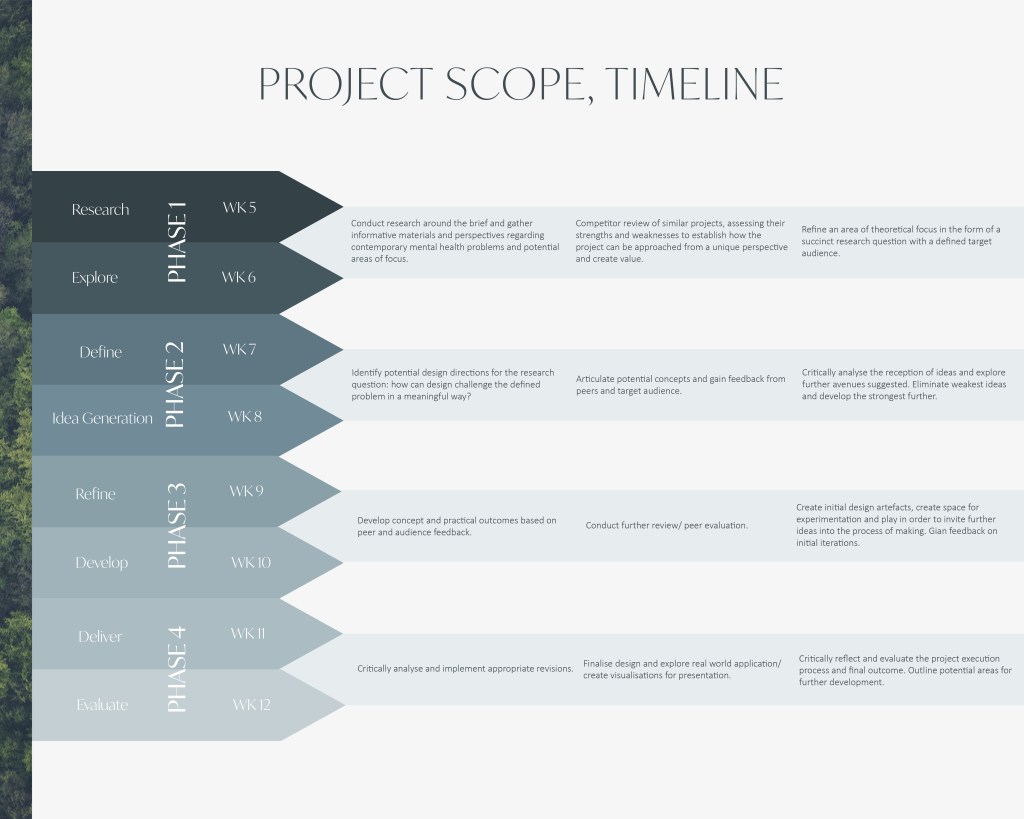
- Phase 1: Visual audit of existing company work and competitor portfolios
- Phase 2: 6 design concepts that meet business objectives
- Phase 3: Test all concepts with target audience
- Phase 4: Test 3 concepts, refine and retest
- Phase 5: Select 1 concept, fully develop and perform testing
- Phase 6: Develop approval presentation
- Phase 7: Implement approved design solution
- Phase 8: Develop measurement metrics
Category Review
Analysis on company’s position within the market place and its relationship with competitors, informed largely by market research groups, however useful to the design process as it enables the designer to identify possible solutions and appropriate approaches. Eg. Phillips’ example included information on the company’s vast market shares and company age, enabling the designer to recognise that brand equity must be maintained throughout the redesign in order to leverage the company’s heritage and reputation in a competitive marketplace.
Target Audience Review
Critical analysis of the target audience’s age, interests, income, level of education and ‘sophistication’. This informs the design strategy by exploring various subcategories within the target audience and their relationship to different tiers of the product line, eg. the basic – high end range and at what point might they transition from basic to expensive? The complexity of Phillips’ analysis made me think more critically about how various factors such as age and education, influence human priorities and subsequent consumer behaviour. For instance, elderly people were more likely to invest in reliability whilst more new home owners/ independent livers would opt for the basic range.
Company Portfolio
Clearly defines the breadth of the project and succinctly defines what artefacts are to be designed. Phillips’ additional analysis highlights strategic ways in which the design team might visually organise this information through charts. In addition to gathered competitor designs, this contributes to a ‘giant matrix’ that demonstrates the scope of materials needed for a visual audit to assess the brands areas of strength and weakness.
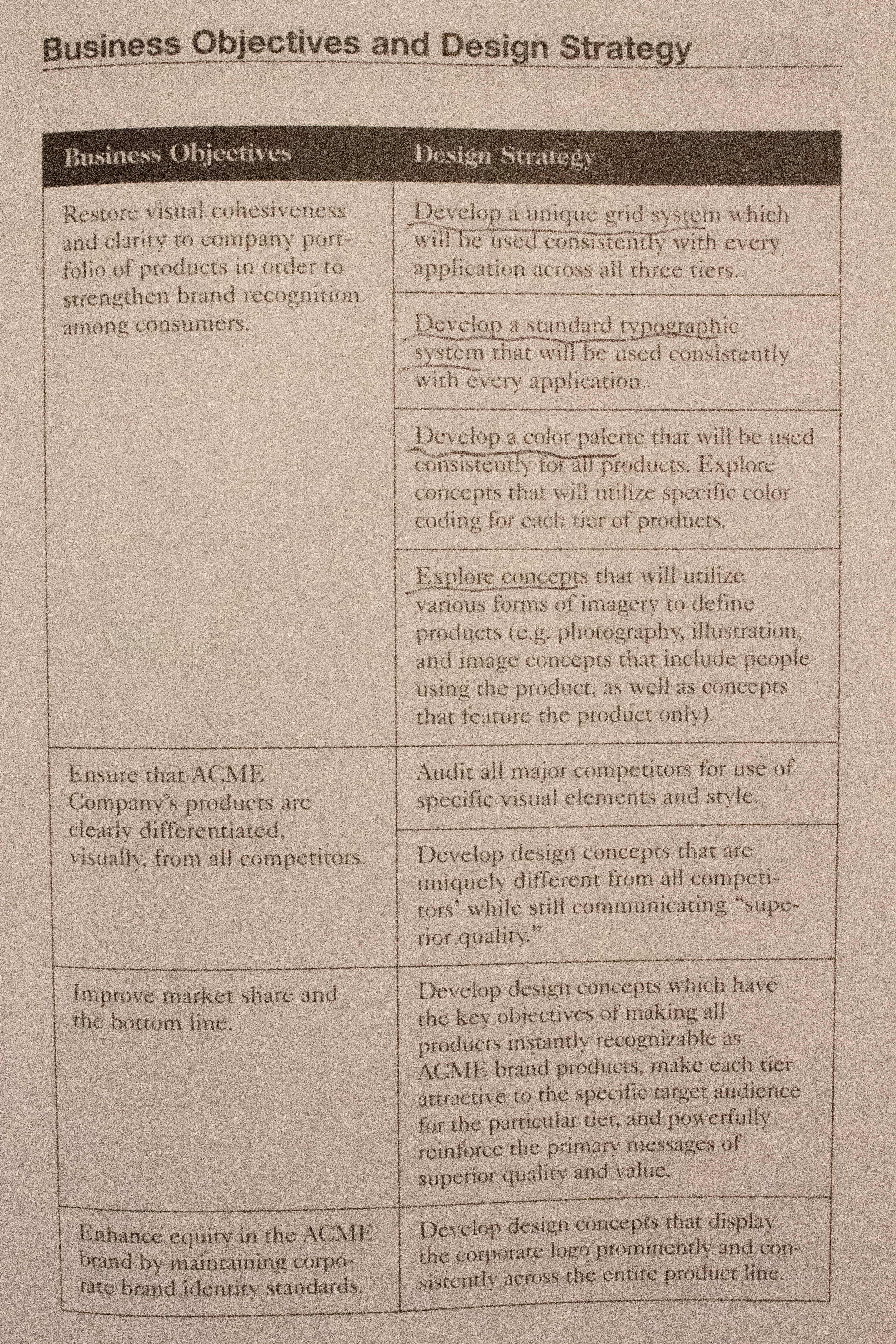
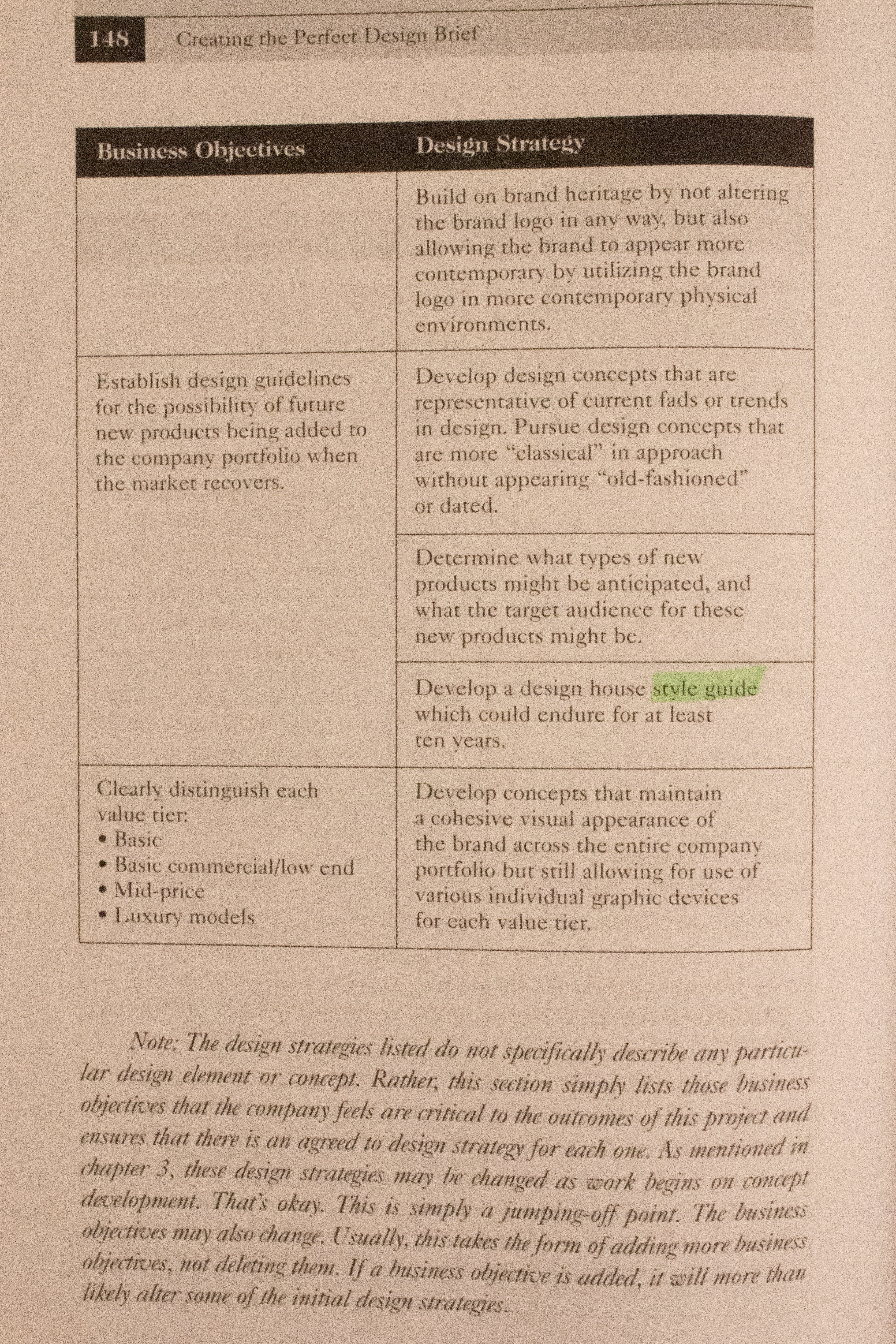
Business Objectives and Design Strategy
Project Scope, Timeline, and Budget
Analyse each phases in accordance with time, labour, overheads etc.
Research Data
Outline missing data necessary to the project and why: In Phillips’ case this is an R&D forecast for new types of products under development as this informs the development of design standards, guidelines, principles and strategies for the future.
Appendix
The appendix should be updated with new material as it’s completed: Phillips notes the importance of the appendix becoming important ‘archival material for future projects’. “Very often, materials from one project will be absolutely essential to another project. Why keep reinventing the wheel? Archive your design briefs”.
Chapter 12: Anticipating and overcoming obstacles. (Pages 161 – 166)
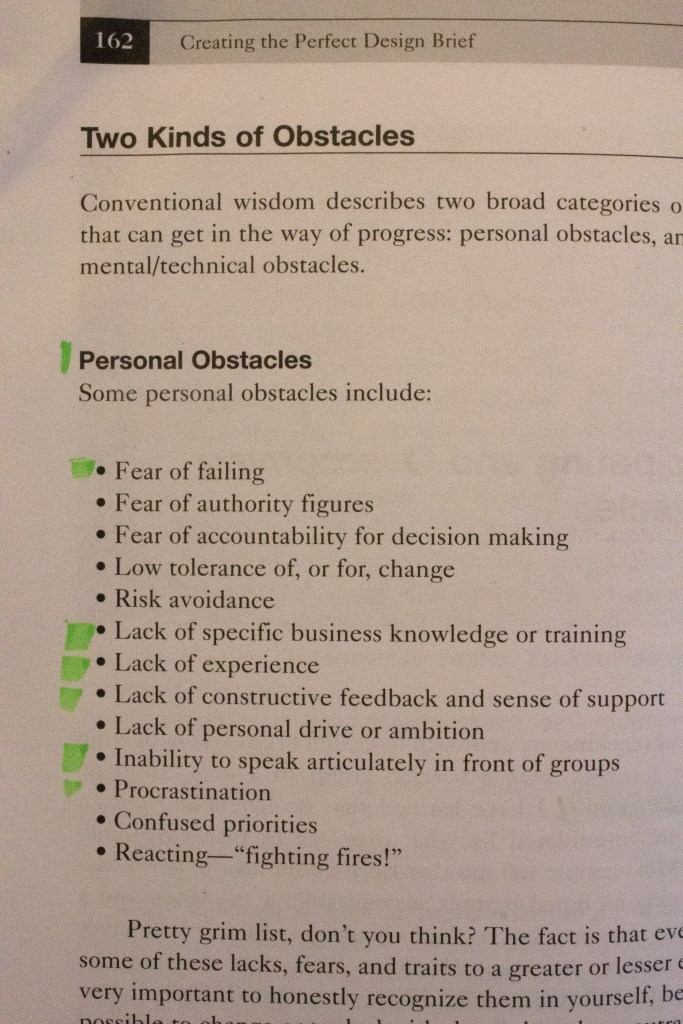

The application of Phillips’ analysis of personal and environmental obstacles was extremely useful and empowering both in the context of both my academic and professional work. Chapter 12’s emphasis on self honesty regarding ones own weaknesses and fears highlights our potential to recognise unhelpful behaviours and challenge them in isolation. Also, it was helpful to acknowledge and identify which obstacles are within our capacity to control and which are not. Much anxiety can arise from the suspended sense of feeling obliged to resolve or act on an issue which is beyond our control – in the context of design projects, acknowledging these unalterable obstacles gives the designer clear parameters to work within.
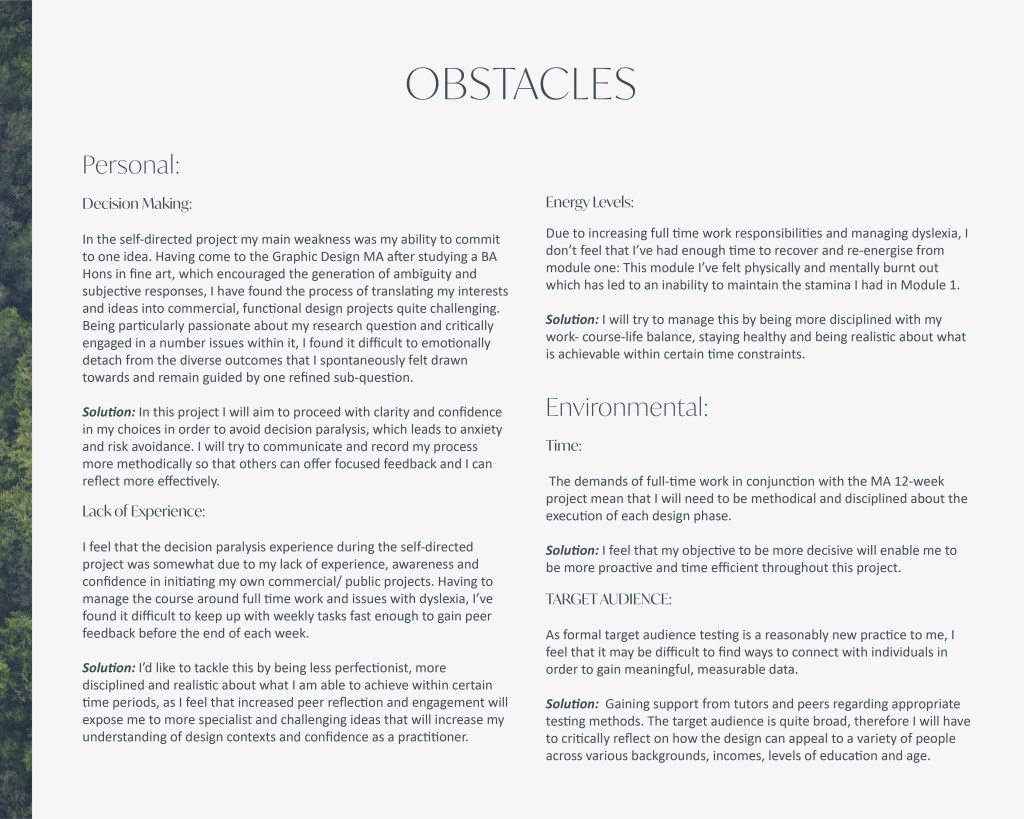
Obstacles
Personal:
Decision Making:
My major weakness in the previous self-directed project was my ability to commit to one idea. Having come to the Graphic Design MA from a fine art academic background which offers licence to create critically informed, yet ambiguous subjective outcomes, I have found the process of translating my interests and ideas into commercial, functional design projects quite challenging. Being particularly passionate about my research question and critically engaged in a number issues under the umbrella topic, I found it difficult to emotionally detach from the diverse outcomes that I spontaneously felt drawn towards and remain guided by one refined sub-question. In this project I will aim to proceed with clarity and confidence in my choices in order to avoid decision paralysis, which leads to anxiety and risk avoidance. I will try to communicate and record my process more methodically so that others can offer focused feedback and I can reflect more effectively.
Lack of Experience:
I feel that the decision paralysis experience during the self-directed project was somewhat due to my lack of experience, awareness and confidence in initiating my own commercial/ public projects. Having to manage the course around full time work and issues with dyslexia, I’ve found it difficult to keep up with weekly tasks fast enough to gain peer feedback before the end of each week. I’d like to tackle this by being less perfectionist, more disciplined and realistic about what I am able to achieve within certain time periods, as I feel that increased peer reflection and engagement will expose me to more specialist and challenging ideas that will increase my understanding of design contexts and confidence as a practitioner.
Energy Levels:
Due to increasing full time work responsibilities and managing dyslexia, I don’t feel that I’ve had enough time to recover and re-energise from module one: This module I’ve felt physically and mentally burnt out which has led to an inability to maintain the stamina I had in Module 1. I will try to manage this by being more disciplined with my work- course-life balance, staying healthy and being realistic about what is achievable within certain time constraints.
Environmental:
Time:
The demands of full-time work in conjunction with the MA 12-week project mean that I will need to be methodical and disciplined about the execution of each design phase. As discussed, I feel that my objective to be more decisive will enable me to be more proactive and time efficient throughout this project.
Chapter 13: Creating a plan for moving ahead. (Pages 167 – 172)
How do you ensure your project is strategically aligned to allow for its development in relation to client and audience needs?
- Clearly identifying a refined solution to be explored, informed by a focused business/ social objective.
- Clearly identifying a target audience, analysing its complexity and its changeable relationship with the project.
- Implementing appropriate audience research methodologies.
“Design always carries an intension: calling for different realities to come into being”.
Lecture with Ben Evans James: The role of design in the big questions:
Critical Reflection:
Ben’s lecture repositioned my perspective regarding the social role of design and its capacity to communicate allegorical messages which transcend the context of their production. For instance, design is evidenced used to communicate with the future regarding subjects of environmental ethics through visual sign posting.
Having previously explored design as an instrument of activism, the idea of progress and failure through “self-deception” led me to reflect on the potential for design to break comfortable conventions and be informed by a multitude of perspective in order to avoid providing “socially expected solutions”. The idea of design with “good intensions” acting as a “plaster for a wound rather than challenging the problems within society” led me to further interrogate the relationship and discrepancies between fine art and design and consider how design artefacts can be produced to interrupt detrimental consumer habits and social norms.
The idea of ‘navigating grey space’ inspired me to consider cross disciplinary collaborations or research methodologies which would enable me to step outside of design in order solve big problems, “visualise something unseen” and “reinvent modes of communication”.




 CATHY DAVIES